
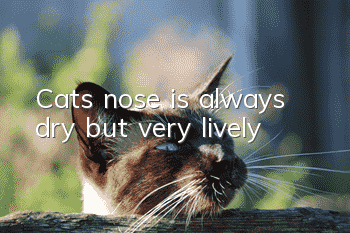
My cat's nose is wet, could it be a "cold"?
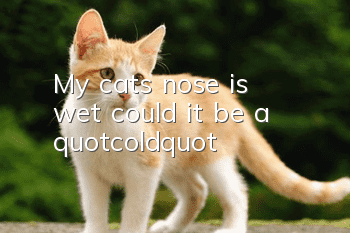
The dryness and wetness of a cat’s nose is of great significance. Let’s talk about the cat’s nose in detail below.
01
When a cat comes to be intimate with you, it will usually nudge you with its nose, leaving a wet patch on your hands or face.
If you don’t know the truth, you may feel:
Is my cat sick?
Because if our noses are wet, it usually means we have caught a cold.
But it’s completely normal for cats to keep their noses appropriately cool and moist.
Part of the moisture above the nose comes from the secretion of sweat glands on the nasal plane, and part comes from the lower tear ducts.
Moisture from the lower tear ducts may be more in Exotic, Persian, and flat-faced breeds.
02
In most suitable environments, a cat’s moist nose mainly serves two functions:
The first function is to dissipate heat, as mentioned above;
The second function is that a moist nose helps capture odor particles, thereby helping to improve the sensitivity of the sense of smell.
03
Generally speaking, if the cat’s nose is slightly moist and slightly cold (compared to the armpits),
That means the cat’s body is in a healthy state,
Of course, excessive moisture is also a problem, which we will talk about later.
However, it should be emphasized here that just because a cat’s nose is not cold and dry does not mean that it is unhealthy.
A cat’s nose is relatively dry when sleeping, but it usually becomes moist again when he wakes up.
In addition, if the environment where the cat is located is relatively warm,
For example, it is basking in the sun in the sunroom in the afternoon,
At this time, you may notice that its nose is not only dry, but also warm.
Therefore, if you really want to judge the health status of a cat through its nose, you must also pay attention to other physical characteristics of the cat. Only by combining them can the judgment be more accurate.
For example, you find that your cat’s nose temperature and humidity suddenly change, accompanied by:
Strong thirst,
Frequent urination,
Drowsiness,
No appetite,
Weight loss,
Vomit,
When symptoms such as diarrhea occur,
Then you need to take it to the hospital for examination.
04
A healthy cat will not have a runny nose often, but occasionally one or two drops of clear liquid will flow out, which is generally not a big problem.
Cats’ own immune systems are also very powerful.
Minor illnesses and disasters can usually be overcome by oneself, and in the process, the immune system is strengthened.
But if you find:
The cat is indeed having sticky mucus or bubbles,
If you still sneeze from time to time, you need to pay attention.
Especially cats under five months old.
If this happens frequently, it is very likely to be nasal bronchitis. If the cat has not been vaccinated, the possibility will increase several times.
05
Nasal bronchus in cats is a relatively common disease in kittens. I won’t expand on it today. In fact, I have written some articles about nasal bronchus in cats before.
Cat rhinoplasty is one of the typical diseases affecting the upper respiratory tract of cats.
Cat’s upper respiratory tract diseases are also the most common diseases received by veterinarians.
The two most common viruses causing upper respiratory tract infections are: herpes virus and calicivirus (Calicivirus).
Other bacteria that may cause problems include: Chlamydia, Bordetella, Mycoplasma, Streptococcus, etc.
Related articles
Random articles
- What kind of cat is an orange cat? How much does one cost?
- How should I educate my cat when he poops on the bed?
- What is the personality of the Chinese civet cat?
- What does the Cheshire Cat's smile mean?
- Pregnancy care tips for British longhair cats
- What does it mean when a cat lies belly up?
- Does a Ragdoll cat's personality change when it's in heat?
- Why do cats get calicivirus and the best treatment plan for feline calicivirus!
- What are the symptoms of a kitten having a bad heart?
- Why do cats keep purring?