

What are the symptoms of genetic defects in folded-eared cats? When does the genetic defect occur?
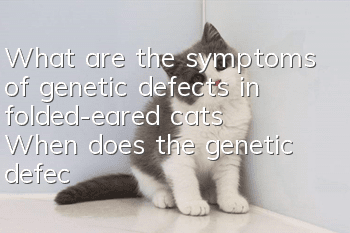
Chondrodysplasia in the folded-eared cat breed is caused by the dominant gene (Fd) on the autosomal chromosome. Takanosu et al. proposed in 2008 that this is actually an incomplete dominant gene, which means that this dominant gene A sex gene cannot completely mask the trait expressed by another gene in the allele. The genetic defect of folded-ear cats is a hereditary bone disease that cannot be cured, and most of the disease will continue to worsen and cannot be cured. The only way to avoid this genetic disease is to give up breeding fold-eared cats.
Fold-eared cat genetic defect
1. Fold-eared cats are a genetic disease caused by a dominant gene on an autosomal chromosome. Now people believe that this is actually an incomplete dominant gene. All Scottish Fold cats that are homozygous for the folded ear gene have two mutated genetic genes (Fd/Fd) and will be severely affected. All Scottish Fold cats that are heterozygous for the folded ear gene have a mutated genetic gene (Fd/fd) and will also develop the disease, but the disease is usually mild.
2. Chondrodysplasia in folded-eared cats carrying homozygous Fd/Fd genes. In studies of folded-eared cats homozygous for the gene, the most consistent finding is an abnormally thick and short tail with stiff roots. The cause of this phenomenon is that the tailbone is unusually short, wide, and fused together. Fold-eared cats also have deformed limbs and shorter legs. The metatarsals and metacarpals, the bones between the wrists, ankles, and toes, as well as the toes, may also become deformed and widen, although the deformation of the toes is less severe. Over time, the joints at the end of the limbs will develop disease and osteoarthritis. There will be bone proliferation around these joints, commonly known as exostoses, which will make the joint inflammation more serious and eventually lead to joint fusion.
Initial symptoms of genetic defects in folded-eared cats:
1. The tail of a cat with folded ears is short, stiff, and unable to bend. The tail of some sick cats cannot swing.
2. The hind limbs of folded-eared cats are too short and have unusual bends, growths or lumps.
3. The limb joints of folded-eared cats are swollen.
4. The hind paws of folded-eared cats are abnormally thick. If you observe carefully, when the cat sits upright, the pillow meat of the hind paws cannot touch the ground.
5. The nails of cats with folded ears grow abnormally.
6. Cats with folded ears will also have similar symptoms on their forelimbs, but they are more severe than those on their hind limbs. This is actually caused by stiffness of their hind limbs or pain when flexing.
The period of onset of genetic defects in cats with folded ears:
Cats with folded ears are born with a hereditary bone disease, namely abnormal cartilage-ossification development. All cats with folded ears have a chance of developing some degree of bone and joint disease. This is a typical genetic disease of folded-eared cats. It starts with bone hyperplasia, then bone spurs, and finally paralysis. The onset period ranges from 2 to 6 months of age, but some cases do not begin until after 1 year of age. This hereditaryThere is no cure for bone diseases, and most of them will continue to get worse and cannot be cured. The only way to avoid this genetic disease is to give up breeding fold-eared cats.
Related articles

Random articles
- Why does a cat eat less?
- After the cat eats the cat food, it makes the action of digging the cat litter
- Can cats develop gills after being neutered?
- How many days can a cat take a bath after being vaccinated? Do you really know?
- What toys are suitable for cats, and how should you choose toys for your cat?
- What should I do if my cat sticks out its tongue and has shortness of breath when it’s hot?
- Why do cats smell people's noses?
- Can I raise sunflowers if I have a cat at home?
- What does it mean when a cat bites someone's hand?
- The cat keeps meowing with its tail raised