

How are dogs trained?
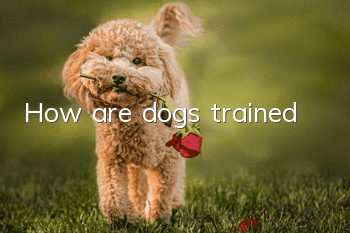
Regardless of whether they are police dogs, hounds or reward dogs, there are many training subjects. In order for the trained dog to be able to perform actions smoothly according to the owner's commands and gestures and accurately complete various tasks, the training essentials must be correctly mastered so that the dog can Quickly develop good and stable conditioned reflexes. (1) Induction Induction is a means of using food, objects, own behavior and other factors to induce dogs to perform certain actions during training, thereby establishing conditioned reflexes. This method is instructive and can arouse the appetite of the dog. Especially the food that the dog likes to eat will make the dog more excited, so that the dog can actively participate in the training and learn the movements faster. Since this kind of stimulation is active, the actions made by the dog are naturally lively and willing to execute, especially the training effect of using subjects is better. However, its disadvantage is that it cannot guarantee that the dog will be able to perform the actions smoothly and accurately as required under any circumstances, especially when the method is used improperly, such as excessive reward and food. Therefore, when using this training method, you should pay attention to the following three points: First, the timing of using induction should be mastered, and it should be combined with a certain intensity of coercive means. This can not only ensure the smooth progress of training, but also maintain the excitement of the dog. sex. Avoid using inducements instead of commands and gestures. Secondly, it is necessary to prevent bad associations due to induction. For example, if some dogs carry objects but do not hold them, it is caused by carelessness during training. Third, it should be used appropriately according to the dog's nerve type and characteristics. Dogs that are calm, quiet, and not too excited can use it more, while dogs that are excited and flexible should use it less. (2) Force Force is the use of mechanical stimulation and threatening tone commands to force the dog to perform accurate actions. The forced method is mainly used in the early stage of each training subject, that is, in order to strengthen the formation of conditioned reflexes, it is used in the early stage, or when the scheduled subject cannot be carried out under the influence of external incentives. But we should pay attention to the following two points: First, when using coercion, we should pay attention to timeliness and moderation, combining commands with mechanical stimulation of corresponding intensity, and combining them with rewards. Excessive coercion can easily cause dogs to become inhibited and affect their attachment to people. When the dog makes a correct action, in order to ease the dog's nervous state and consolidate the conditioned reflex, sufficient rewards (food or petting, etc.) should be given so that the dog knows what to do and what not to do. Second, it should vary from dog to dog and subject to subject, and should be used with caution to avoid adverse consequences. (3) Prohibition This is a method taken to stop the bad behavior of dogs. It uses a threatening tone to issue the "no" command, and is used in combination with powerful mechanical stimulation. If a dog is chasing livestock or poultry, picking up food anywhere, or biting people, the "no" command should be issued, and at the same time, strong mechanical stimulation should be used to stop it. The following two points should be noted when using the prohibition command: First, when stopping the dog's bad behavior, the owner's attitude must be serious, and the stop must be timely. The most effective time is to stop the dog immediately when the dog shows bad behavior. A serious attitude is by no means synonymous with beating and scolding. Whenever the dog stops after hearing the order, it must be rewarded. Second, the stimulus intensity must beTreat the dogs individually according to their characteristics, especially puppies. When the "no" command has formed a conditioned reflex, that is, when the dog can stop immediately after hearing the command, mechanical stimulation should also be frequently combined to prevent the reaction from fading. (4) Rewards Rewards are a means to strengthen the dog's correct actions, consolidate the developed abilities, and adjust the dog's nervous state. Reward methods include feeding, petting, allowing walks and praise (giving the "good" command), etc. Generally, in the early stages of subject training, in order to quickly form conditioned reflexes and consolidate the learned actions, food and petting should be the main method, combined with praise and rewards. Pay attention to the following two points when it comes to rewards: First, rewards must be timely, and different reward methods should be used according to different situations. Second, when rewarding, the owner’s attitude must be amiable.
Related articles
Random articles
- How to change dog food for dogs?
- How to train a dog to need shoes? Dog training tips!
- What kind of shower gel should a Shiba Inu use when bathing?
- golden retriever ear discharge
- Description of the morphological characteristics of the American Bully Dog
- What are the benefits of neutering a female dog?
- Feeding precautions for Samoyed puppies
- The correct way to bathe your dog
- Can dogs eat steamed corn?
- Ten signs that dogs have low IQ