

What to do if your dog has ear inflammation - Scientific Treatment and Care Manual

Treatment measures for dog ear inflammation
1) Before treatment of dogs with acute otitis externa infection, the external auditory canal should be blocked with absorbent cotton balls, then the surrounding hair should be cut off, and treated with normal saline, 0.1% Xinjiazuride or Rinse the external auditory canal with 3% hydrogen peroxide solution.2) When flushing, tilt the dog's head toward the affected ear to facilitate the flow of flushing fluid, then remove the cotton ball plugged in the ear canal, and then use a dry cotton ball to absorb the fluid in the ear canal.
3) Use an otoscope to examine the deep part of the external auditory canal, and use otological forceps to remove foreign bodies, earwax or tissue fragments from the deep part, and finally apply boric acid glycerin (1:20) solution or tannin glycerin (1:20) solution to the external auditory canal. Apply 2 to 3 times a day.
4) For suppurative otitis externa, apply antibiotic ointment to the ear canal after cleaning according to the above method.
5) In severe cases, rinse 1 to 2 times a day and then apply ointment. Dogs with obvious systemic symptoms can be treated with systemic antibiotics. External ear drainage should be performed on sick dogs with deformed ear shells or tumors.
Symptoms of dog ear inflammation
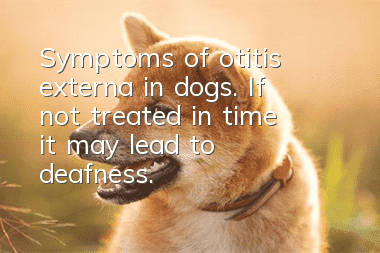
Dog ear inflammation is divided into otitis externa and otitis media. The initial symptoms include flushing, edema, and itching of the external auditory canal, and light yellow serous secretion flowing from the ear canal. objects, contaminating the coat under the ears.Dogs often show restlessness, often shaking their heads, or scratching their ears. As the disease progresses, local swelling intensifies, or pustules appear, and brown-black foul-smelling purulent secretions flow out. This often leads to hair loss at the base of the ears or dermatitis, and the sick dog's hearing decreases.
When it becomes chronic, it will be good and bad, with recurring attacks, and can cause the tissue of the ear canal to thicken, and even tumors to occur, resulting in thickening of the auricle skin, deformation of the auricle and hearing impairment.
In severe cases, inflammation invades the facial nerve and parasympathetic nerve, causing facial paralysis, dry keratitis and tympanic membrane perforation visible on nasal mucosal otoscopy.
Related articles

Random articles
- Signs of old age and death of dogs. Dogs with these symptoms may be about to die.
- Reasons why dogs grind their teeth In addition to growing teeth, there are other reasons why dogs grind their teeth.
- An introduction to early pregnancy symptoms in Anatolian Shepherd dogs. Do you know the symptoms of dog pregnancy?
- What to do if your golden retriever smells bad? These tips will teach you how to reduce your dog’s body odor.
- Which brand of dog molar stick is good? How to distinguish what kind of molar stick your dog needs?
- How does a Russian Borzoi produce milk after giving birth? What owners need to know most about how to produce milk after giving birth!
- What are the symptoms of dogs getting angry and what medicine should they take?
- When does the Russian Borzoi go into heat? Instructions for owners to care for the Russian Wolfhound during the period of heat
- Why do golden retrievers smell? Do you know these reasons?
- Precautions for dog teething sticks What should dogs pay attention to when eating teething sticks?