

Siamese cat: the chameleon of the cat world!
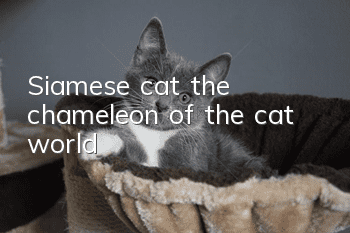
Anyone who knows something about Siamese cats knows that it is not an exaggeration to say that they are the "chameleons of the cat world". The coat color changes with age, body temperature, and environmental temperature. The colder it is, the darker it is, and the higher the temperature, the whiter it is. Therefore, many Siamese puppies just born from their mother cats usually have white fur. As they grow and their body temperature changes, dark patches begin to appear.
Such mutations are related to genes. According to "Genetics" in "Wikipedia", an "enzyme" responsible for producing pigments in Siamese cats contains a mutation. This mutation can cause this enzyme to become unstable at high temperatures. stable and loses its functionality. Therefore, the coat color is darker in areas where the cat's skin temperature is lower (such as limbs, tail, face, etc.), while the coat color is lighter in areas with higher body temperature.
In addition to Siamese cats, there are also some cats with "key color patches" that have a similar situation. For example, Ragdoll cats, Himalayan Persian cats and some Taiwanese Mix cats often appear to be "completely white" when they are young, but "completely different" when they grow up.
In cold and low-temperature environments, Siamese cats’ hair becomes pigmented and has more dark parts. Therefore, the patterns and colors of Siamese cats will be subtly different at high latitudes and at low latitudes. The owner can also observe whether the color of its coat has turned lighter to infer whether it has a fever.
The most obvious example is that newborn babies are usually whiter because the womb is very warm. As it grows, the coat color will change from all white to light brown, and then the coat color will begin to darken in the nose, ears, tail, and limb pads where the body temperature is lower. The entire face of some Siamese cats is dyed dark brown by pigment, while the parts of the body with higher body temperature remain light brown or grayish white.
Interestingly, if a Siamese cat is unfortunately injured and the body temperature of the area wrapped by the bandage becomes high, when the bandage is first removed, it will be found that the new hair growing in this area becomes lighter or even completely white, and will slowly fade over time. Slowly restores original color. Therefore, it is not an exaggeration to call the Siamese cat the "chameleon of the cat world"!
Related articles


Random articles
- Do male cats know their babies?
- How to care for Norwegian forest cats after neutering?
- Symptoms and prevention and treatment of cat mastitis
- How to treat atopic dermatitis in cats
- What does cat grass do to cats?
- Why do cats lick their lips? 7 reasons why cats lick their lips
- What is the best age to neuter a Norwegian forest cat?
- How many days can a kitten eat by itself?
- What should you pay attention to and prepare for deworming kittens?
- Do exotic shorthair cats have gills?