

What's going on with the black mud inside the ears of a folded cat?
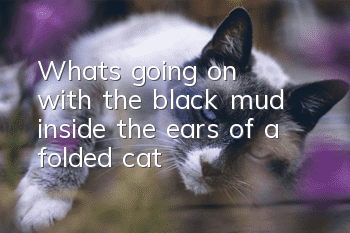
The black mud inside the cat’s ears may be ear mites, which are common ear canal parasites in cats. In most cases, they are parasitic in the ear canal. In rare cases, they can also appear on the head, neck and tail. Ear mites will cause cats to scratch and flick their ears frequently, and the number of mast cells and macrophages in the ear canal will increase significantly. Two weeks after infection, large amounts of IgE antibodies are produced, leading to allergic reactions.
Cats with ear mites will have red and swollen ears, hair loss, or a large amount of black dry earwax. If you find large pieces of black earwax falling out of your cat's ears, it is also one of the symptoms of ear mites. The cat keeps scratching or shaking its head crazily because its ears are itchy. When black earwax appears, it is very likely that otitis media has occurred.
It is necessary to treat ear mites in time with a medicine that treats ear mites, such as ear mites. First stabilize the cat, place the mouth of the bottle at the mouth of the ear canal, and gently squeeze the bottle body to release the ear canal cleaning solution into the ear canal. Let the potion sit in the cat's ear canal for two to three minutes, and then wait for the cat to shake its head to shake out the earwax and secretions. After the cat shakes its head, you can use cotton balls or paper towels to wipe the dirt on the cat's auricles. This should be done several times until the cat recovers.
Related articles

Random articles
- How to comfort a cat with irritated fur?
- What is the function of cat meat pads?
- Why is the cat shivering after vaccination? Is it a drug allergy?
- Why do I have soft stool after eating canned Miao Xian Bao?
- Precautions for internal and external deworming of cats
- How does a cat adapt to its new home when it first arrives?
- Cat plague will get better after a few days
- Can cats with autism heal themselves?
- Kitten eating habits: feeding frequency is the key
- Small animal ophthalmic emergencies and treatment - overview