

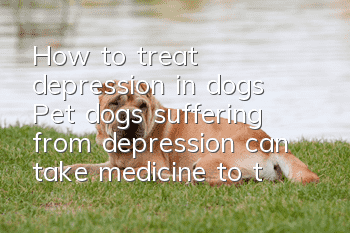
How to treat depression in dogs? Pet dogs suffering from depression can take medicine to treat it
Animals have their own set of thinking patterns
In the 20th century, with the rise of a field called cognitive ethology in the past 30 years, thousands of years of Western thinking about animals have changed. Arguments without ideological binary oppositions. The dominant idea in this emerging discipline was that it was unscientific to think that animals think and feel exactly the same way we do, and that it was equally foolish to think that animals couldn't think and feel at all. In laboratory experiments and field observations, researchers have found evidence of analogical reasoning in apes, counting in rats, and pigeons' ability to distinguish paintings by Picasso from Monet. They demonstrated that animals can understand basic abstract concepts such as "sameness" and "difference" and can use their intellectual abilities to solve new problems. Perhaps it’s not surprising that we can teach a parrot to distinguish colors or a dolphin to distinguish between a surfboard and a Frisbee; we have long assumed that these animals are wary. But research shows that bumblebees can remember the location of flowers they have picked, and cockroaches can tell the difference between familiar people and strangers.
Behavioral pharmacology gives pets a set of named states
Cognitive ethology has a much harder time bringing together the evidence on animal emotions. For pet owners who pet a purring cat or watch a dog prance around, it seems intuitively obvious that animals have emotions. But intuition isn’t hard science, just more intensely human. Enter behavioral pharmacology, which offers a new window into the minds of animals. Dr. Dorman was a pioneer in the field and founded the Animal Behavior Clinic at Taft University. The qualifier for skepticism, he says, is how you can tell that a highly active dog on a walk is actually a sign that it's feeling anxious. Dorman would reply, "Let's give him an anti-anxiety pill and see what happens."
Animals do have their own spiritual world
After 30 years of experiments, it has been proven that animals do have their own spiritual world, which can also lead to mental problems. It is estimated that more than 14% of dogs in the United States suffer from separation anxiety disorder. Symptoms include self-destruction, prolonged howling, barking or drooling, or standing alone in front of the door all day. Like humans, these symptoms require medication and behavioral retraining, but some people are just lazy. An estimated 25% of pet owners actually don't follow his treatment recommendations. They just want a magic pill that will fix the problem once and for all. Don't rely solely on medications. If you combine behavioral changes with medication, depression can take a turn for the better.
Related articles


Random articles
- How to train dogs to delay. Sit, lie and stand: basic delay training for dogs.
- Precautions for feeding a Husky Feeding and precautions for an 8-month-old Husky
- The history of blood and tears of raising huskies. Raising huskies requires an owner and sufficient mental preparation.
- Rabies Vaccine Misunderstandings Rabies Vaccine Knowledge Misconceptions Cleared
- Husky Grooming and Hair Care Guide to Husky Grooming and Hair Care
- Training a Schnauzer to defecate in a fixed place. How many days does it take for a dog to learn to defecate at a fixed place?
- Dogs Breathe Heavy Reasons Why Pet Dogs Breathe Heavy
- Interpretation of Dog Sleeping Positions Revealed Secrets of Dog Sleeping Positions
- Can dogs wear socks? A collection of questions about dogs and socks
- Hygiene precautions for raising dogs: Clean frequently to reduce cross-infection with dogs