

What are the signs of giving birth to a Poodle?
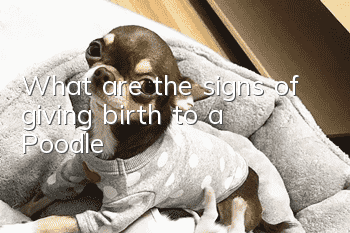
What are the signs of a Poodle giving birth? Before the Poodle is born, the breasts will be swollen and full, the nipples will be pink and swollen, and some will begin to secrete milk; some Poodles will have a loss of appetite a few days before giving birth, and will reduce their food intake, or even stop eating. It may be that she is about to give birth; in the third trimester of pregnancy, Poodles will significantly reduce their activity and lie down to relieve abdominal pain and reduce physical energy consumption.
When a Poodle is about to give birth, its belly will be very bulging and pink, its breasts will be swollen and full, and its nipples will be pink and swollen. Some Poodles may even overflow with milk a few days before giving birth. If it is the first litter, you can observe and record these conditions to facilitate the care of future puppies.
Abdominal pain before delivery, and many Poodles will have loss of appetite a few days before delivery. If you have reduced food intake, or even stop eating, but are not listless, you may be in labor. In addition, stillbirth may also cause abdominal distension and loss of appetite, but in this case, the baby will generally be depressed, and due to hemolysis of the stillbirth, the belly will be dull or even dark red.
In addition, Poodles during pregnancy will also be very active. As long as they are not kept in captivity, they will exercise appropriately on their own so that the baby is healthy and the birth is smooth (Poodles who exercise less during pregnancy may have difficulty in giving birth). However, poodles are also very smart. In the third trimester of pregnancy, a few days before delivery, usually two or three days before delivery, due to the baby's weight, reduced food intake, delivery preparations, labor abdominal pain, and to prevent activities from injuring the baby, etc. , the mother dog will significantly reduce the amount of activity and lie quietly most of the time to relieve abdominal pain, reduce physical energy consumption, and prepare for giving birth to a baby. Note that he was lying quietly, not sleeping like usual.
Pregnant poodles, especially free-range native dogs, will make nests one or two days before giving birth. This behavior is an innate inheritance of animals and is a preparation for childbirth. Most poodles have varying degrees of performance. Specific manifestations include suddenly becoming active from being quiet, crawling into dark corners, piling up objects, dragging and biting soft objects, going around kennels, building nests, etc. At this time, you should pay attention. The poodle is about to give birth to a baby, which will only happen in a day or two. It is time to make preparations.
Within 24 hours before delivery, the amniotic fluid will break. If you see the amniotic fluid coming out of your poodle, the baby will be born soon. In many Poodles, their amniotic fluid breaks only a few hours before giving birth, especially those that are free-range. The amniotic fluid will come soon after delivery, and may even come during delivery. However, for some Poodles that are raised in confinement, the amniotic fluid will not break. Came earlier.
Pregnant Poodles, when the amniotic fluid comes, will bark to a certain extent due to the abdominal pain during labor, some even bark wildly, crawl around, and run back and forth. This situation will continue until the end of the birth. However, some poodles, especially free-range poodles, can easily give birth naturally because they are free to move and exercise and do not overeat. They will not bark before giving birth and during the birth process. It is produced very quietly.
Related articles

Random articles
- How to raise Central Asian Shepherd puppies
- Why is Teddy clingy?
- Can Samoyeds eat fruit?
- When should Teddy dogs shave their lanugo?
- What are the characteristics of Samoyed?
- How to raise Pekingese dogs
- How do you judge whether Beijing is pure or not?
- What kind of meat do Samoyeds eat?
- What are the feeding methods of Bichon Frize?
- How do Pekingese dogs age?